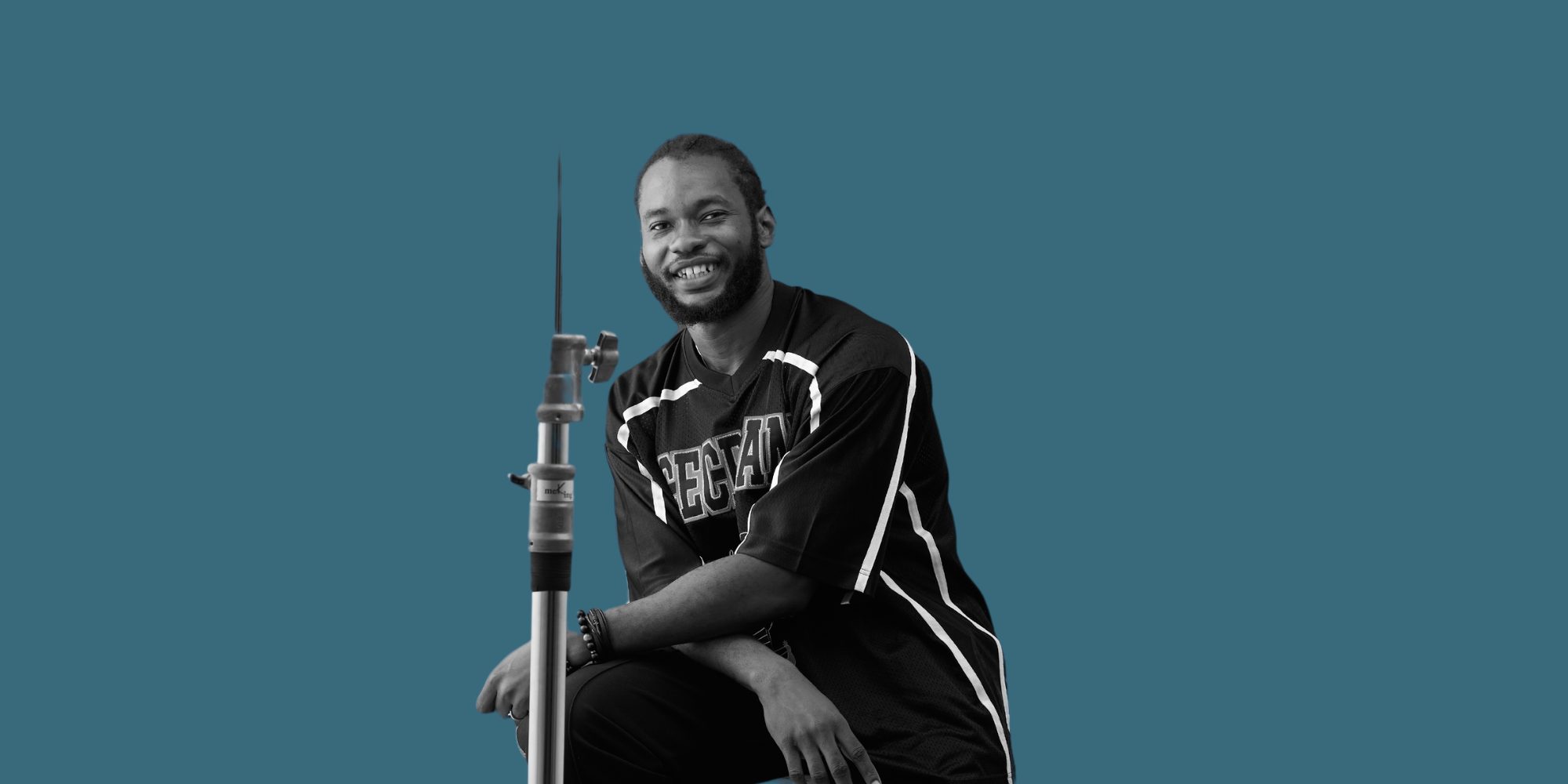
Habib Olawale believes that with the right marketing, you can make anything ‘cool’. That principle has guided his work with Smileys, a dynamic athleisure brand that has built a community around self-expression through clothing and accessories. Habib spoke to PiggyVest about how research and marketing have driven the growth of Smileys, the importance of building strong customer relationships, and how he balances entrepreneurship with paid employment.
Hi Habib, please can you tell us about yourself?
My name is Habib Olawale, I’m the founder of Smileys Africa. I’m also a marketing professional with some level of marketing experience. I love doing active things, I play football, I cycle, and I used to run. I enjoy watching football and playing FIFA and I’m a Chelsea fan.
I’m also a fashion enthusiast, I love consuming fashion content and applying it to my personal style.
Tell us about your first job
My first job was a product marketing internship at a tech company called Vericore. They created educational content for children. Although my role was in product marketing, my primary focus was digital marketing. This led me to leave Vericore after three months to join Ingressive Capital, an investment company, where I worked for two years.
While at Ingressive, I experienced burnout, partly because I had worked three straight without ever taking leave or making time to prioritise my mental health.
Thankfully, it was around this time that I got the idea for Smileys and started experimenting.
Interesting. What was your original plan for Smileys?
I didn’t originally plan to make money from Smileys. While working on a project, I researched the top searched products on Jumia and other online retail platforms. I was surprised to find socks on the list.
Socks?
Yes, I was confused about the interest in socks, so I checked out brands that sold socks directly to consumers and studied their business models. I was particularly interested in comparing Nigerian brands to European ones, as I found the experience with Nigerian brands lacking in comparison. Seeing this as an opportunity, I conducted further research into the business model, pricing, content experience, user experience, and branding, which guided my approach to creating a better offering with Smileys Socks.
It made sense, and I was already thinking of resigning from Ingressive due to burnout, so I left and devoted my time to Smileys Socks and consulting gigs as side projects.
So you became a full-time entrepreneur?
Not really, I worked on Smileys full-time for two years before joining OurPass as a product marketer. After three months, I became the head of marketing before moving on to Voyance as a product marketing manager. Then I left Voyance after seven months before joining Wesleyan Financial Services in Birmingham, UK.
That’s very interesting. But back to Smileys. How long has Smileys been in operation?
Omo, I would say five years. We started in 2019-ish, but that first year was a beta phase where we did a lot of testing and experimentation, especially on how much people are willing to pay for this kind of service and how excited they were about it. It didn’t feel like work.
What is Smileys now?
Smileys didn’t start because of socks, socks were just the first product that ignited the vision—to create a brand offering quality products at relatively affordable prices. Affordable pricing is relative to the market, but we appeal to a certain demographic and that has informed our decision-making in the business. Now we are a full-on athleisure brand that provides athleisure products for our customers, including activewear and casual wear.
I used myself as the first customer and used my spending power and taste to guide our initial choices. Other Nigerian brands sold socks for around ₦5,000 per pair, but we disrupted the market by offering socks of similar or better quality for just ₦1,000. As our customer base grew, we began experimenting more and adding new products.
So pricing is how Smileys has distinguished itself in the market?
Outpricing our competitors is not our unique selling point. The Smileys experience is our USP. The entire shopping experience—easy purchasing, fast delivery, product quality, packaging, and prompt customer care—is influenced by our perspective on the world. We have customers who have been using their socks since 2019 to date.
Smileys is providing quality fashion and athleisure products at a price we think is fair to everybody. Even our new sneaker line is sold at ₦68,500 a piece. SneakeyTitan, a sneaker enthusiast and influencer, reviewed our sneakers and personally told us the price was really cheap for the quality of the product. We were originally going to cost it higher, but we always think of the customer so we settled on a price that was good for the customer and good for the business.
There are so many factors that affect pricing; shipping, forex, and other things. Every time it happens we try to find a balance. We make about 30% to 50% profit on products.
5 Nigerians On How They Are Responding To Nigeria’s Tax Reforms

You mentioned earlier that you took some time off paid employment when Smileys started taking off. Do you think that impacted how much Smileys has grown as a business?
Yes, Smileys recorded a 900% growth from the first to the second year when I worked on Smileys full time. As I said, I didn’t leave because of Smileys, I left because of burnout.
Having the time to focus on Smileys allowed me to work and refine every part of the value chain, from social media to procuring and packaging, I even did deliveries at some point. It never felt like work.
I’ve experienced the difference between working on Smileys part-time and dedicating myself to it full-time. However, I’m not personally making money from Smileys at the moment; all the profits are reinvested in the business. My business partners and I are focused on the growth phase.
You have a business partner. Can you tell us a bit more about him and your work dynamic?
His name is Bolatito. We met at Ingressive, I liked his energy and I pitched Smileys to him. We have a great system for work. I trust his opinion and I trust him implicitly. He is a designer, but he doesn’t really touch the creative parts of the business as much as I do. He handles the branding and accounting while I handle the creative and marketing parts of the business.
At what point did you realise that Smileys could scale into athleisure the way it has now and become ‘cool’ to Nigerians?
I realised Smileys could scale into athleisure and become ‘cool’ to Nigerians when our customers began asking for items we weren’t yet stocking. We responded to this demand by adding complementary products like underwear and beanies and eventually ventured into athleisure. Athleisure is versatile and serves as a great gateway product for a brand like Smileys. We test new items with a small batch, observe customer responses, and gather feedback through surveys before scaling up.
Our first batch of underwear wasn’t really up to our current standard but customers still bought it and were very respectful with their feedback. We took their feedback and improved the next batch to a global standard. We even have repeat customers who buy 20 to 30 pairs of underwear from us every month. We also had a short design called ‘fast and free’. We hadn’t even put it on the website before it sold out. We got an enquiry from customers who were looking for shorts, so we told them about the fast and free. We sold them the pieces we had and through word of mouth, we kept getting customers without even promoting the product.
What has the reception been like to the Smileys brand?
I think the reception has been amazing. Our customers have been supportive. We have a 4.4 Trustpilot rating, which is about 90% customer satisfaction. People buy products from us, they talk about it, share it on their social media, and refer us to their friends and family because they like the product and they like the brand. That makes me very happy because the reception of the business has helped me through many difficult times, giving me purpose and validation.
I’m really thankful to our customers, my team, our partners and suppliers.
Women & Money: Adesope “Oyinademii” Ademola Is Hustling Her Way To A Cocktail Empire
Smileys just expanded into accessories with its first sneaker launch. Why did you choose to go in that direction?
Most Nigerians wear imitation sneakers which cost in the range of ₦30,000 – ₦60,000. We did some research to back this up and noticed that a lot of Nigerian brands make sneakers, and they are quite successful abroad. But most of those brands lean heavily on Afrocentric branding and that doesn’t really appeal to Nigerians in Nigeria.
We saw that as an opportunity to provide quality at a similar price that was functional for multiple occasions and comfortable with all the features of a global standard sneaker. Our goal is always to see how we can improve on the current product offerings.
How do you decide what product to add to the Smileys inventory?
When I worked in product management, I read ‘Hooked’ by Nir Eyal, and in it, he identifies ‘variable reward’ as one of the qualities of a good product. Most algorithms work on a similar principle where they reward your interest in a product or item by offering you similar options with slight variations so you are always excited. We have brought this idea to Smileys where we build on successful ideas but add our own twist to it.
When we started our athleisure line, we added Henley’s because it is lightweight and the zip knitted polo which are similar to regular polos but with slight differences. Both are currently sold out on our website. We keep experimenting and iterating.
Scaling a business requires money. How have you managed to fund these expansions over the years?
Our investors are mostly friends and family. I’m really scared of debt personally, so I try to avoid it as much as possible. During the first few years, we funded the business from our pockets, but once the business started breaking even, we opened it up to angel investors to invest. So far, we have kept up our end of the bargain. But we are at a point where we are starting to consider serious fundraising.
You’ve worked at Ingressive and other financial institutions offering different kinds of tech-enabled services. How has that informed your approach to building Smileys?
Most of the marketing techniques we use are used by tech companies and it has been very helpful for us as a direct-to-consumer business trying to sell via e-commerce.
I worked with Maya Hogan-Famodu at Ingressive and one of the things she taught me is how to leverage relationships, networks and resources. I use this at Smileys so much that Bolatito often says I sound like her. I also worked with Sam at OurPass and learnt how to be aggressive about acquiring customers and converting interest to sales.
How to Fully Recover from a Financial Setback in Nigeria
Working in these spaces allowed me to meet and network with a lot of people and taught me how to grow a business with a growth mindset and to track that growth using clearly defined metrics that we can measure with technology. We collect emails and use email marketing, we optimise our website and all other content from Smileys with SEO, and we track interest with Google Analytics. All of this helps us to stay top of mind with our customers and eventually with conversion.
A lot of business owners in Nigeria struggle with transitioning customers from social media to shopping directly on their e-commerce sites. How has Smileys managed this?
Consumer behaviour in Nigeria tends to be very conversational and low-trust. However, we’ve built trust over the years by actively engaging with our customers. We use Trustpilot for reviews and take all feedback seriously. We also offer incentives like discounts and freebies, exclusively available through our website checkout, and make our links easily accessible across our social media platforms.
When customers contact us via DM, they receive an automated message directing them to shop immediately on the website. We also guide customers who want to buy sold-out items to similar options on the website. Of course, if the clients insist, we will complete a transaction via DM, but often, customers just go to the website because they don’t want to spend an extra 10 minutes back and forth with a customer care agent when they can experience a quicker, hassle-free checkout process on the website.
Covid happened a year after Smileys launched. How did that affect your brand?
Covid was actually good for Smileys. I was at home at the time and working exclusively on Smileys. I was creating a lot of content, like so many people for whom the internet became their playground. I was very good with social media management and content creation and how to use both to drive engagement. I can’t remember how we managed delivery but the end result was that we had a lot of customers. It was the best of both worlds. By the time Covid ended, Smileys had become the go-to brand in Nigeria for socks, especially for people who want to gift.
How have you future-proofed Smileys against the economic anyhowness that is happening in Nigeria right now?
We save in USD or save in Renminbi (RMB). We work with a lot of Chinese suppliers for production and procurement so we send them money in advance. We also order in bulk at a fixed rate in anticipation that when the product gets to Nigeria, we have the demand and margins for it. When the product arrives, we find a way to balance the cost of production and cost of sale so it is comfortable for everyone.
We applied this strategy when we launched Numero Uno, our first sneaker. Our original plan was to sell the sneakers at ₦30,000 to ₦35,000, but between the start of production and the time we were ready to sell, the naira’s value against the USD had halved. As a result, we had to increase the price to maintain profitability, but not so much that we outpriced our customers.
What is your preferred method of saving?
Our savings strategy is focused on setting aside funds specifically for regular and predictable expenses, such as payments to investors, licensing fees, and other recurring financial commitments. This approach ensures that there is enough money available to cover these ongoing costs as they arise
Do you have a plan to keep Smileys financially secure for the next ten years?
Ten years is a very long time. I think of Smileys in terms of two to three-year plans. For us, we feel like we are wasting any cash that we are not actively utilising. We mostly convert our disposable cash into products we can sell. When we liquidate assets, it’s typically to cover expenses or repay investors.
The only long-term plan I can think of for the business is investing in walk-in stores, similar to Lululemon or Zara. Our business is a revenue business, so we need to keep converting money to products and converting the product back to more money. To get the kind of investment we need to enter into physical retail, we need to be able to show our investors the profitability of the brand, and the best way to do that is to sell and reinvest profits into the business.
Are there any financial decisions you have made in the last five years that you are proud of?
Keeping money in USD/Pounds/RMB. Doing this has saved us from the volatility of the forex markets. I’m so proud of our approach to inventory, it might take some time for us to sell our inventory, but they always sell out eventually, and we make a good amount of profit from it.
Are there any financial mistakes you made at the start of building Smileys that you wish you could rectify now?
We save in inventory, so in the past, I have made the mistake of investing in a product without properly testing it and ensuring it resonates with our customers before investing heavily in it. That has led to some losses, but I have learned my lesson. Nothing goes out without proper research and testing.
Also at the beginning, there was no clear demarcation between my personal finances and Smileys’ finances. I have rectified that now, and I really recommend that all business owners do the same.
What advice would you share with other young professionals who are looking to start their creative side hustles?
I do things for the fun of it. It is exciting to do cool stuff. So I would recommend that you do the things that you find cool and interesting, but make sure you understand the economics of your interests and how to make them profitable. Also, always think about the people you are building the product or designing the experience for. Their input matters.
When I was at the University in Ilorin, I used to organise events. My friends and I organised a party that got so big a club here in Lagos invited us to host a second version for them that could rival our party. We understood that people would pay money for our party, but we didn’t approach the planning from a place of profit. We just wanted to do something cool and fun. The club gave us a bad deal because we didn’t approach it as a business but they made so much money from our hosting that they eventually gave a portion of the profits.
That experience taught me that authenticity is important in business, but so is fiscal responsibility. Finding a balance between both is what makes a business successful.