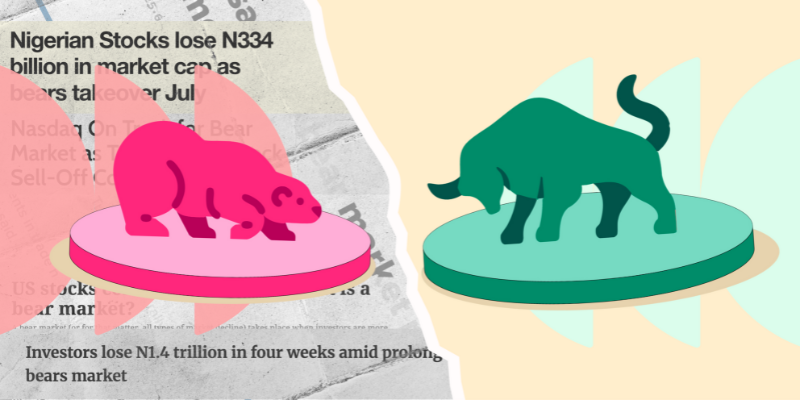
The rise of financial inclusion in Nigeria has made various finance terms part of regular conversation. From “FOMO” and “fiat” to “portfolio” and “ROI,” what used to be regarded as “complex financial jargon” is now popular lingo. But despite common use, these concepts are still as important as ever, especially if you’re a Nigerian trudging the path to financial freedom. Take, for example, “bull market” and “bear market.”
A bull market is a period marked by a continued rise in investment prices and financial optimism, while a bear market occurs when the prices of financial assets fall (accompanied by widespread investor pessimism). Both are part of financial market cycles and impact the economy and your money.
This article will break down what bull and bear markets are in simple terms, help you understand how these market cycles work, and most importantly, show you how you can save and invest effectively, particularly during those tougher economic downturns. So, think of this as your manual for navigating whatever the economy throws your way. Ready? Let’s begin!
How do financial market cycles work?

Imagine the bustling energy of Balogun Market during festive periods like Christmas or Sallah: that’s your bull market — full of optimism, rising prices, and great returns. Now picture a quieter day, perhaps on a rainy day or in the middle of the night (or in the middle of the night during the rainy season), where activity slows down: that’s akin to a bear market.
Financial markets (much like the seasons) move in cycles.
They are natural and involve periods of growth (expansion), peaks & decline (recession), and troughs (bottoms) — all before recovering and starting a new cycle again. Understanding these cycles is crucial because they influence everything from the stock market to the cryptocurrency market and the broader Nigerian economy, impacting your personal finances, job security, and the purchasing power of your savings.
Historically, the Nigerian economy has seen its share of these cycles.
For instance, the Nigerian stock market experienced a significant boom and then a crash around 2008/2009 (one of the most popular bear markets in recent history), partly influenced by the global financial crisis.
During this time, the Nigerian Stock Exchange All-Share Index (or NGX ASI — a number that measures the general market movement of all listed equities on the Nigerian Exchange) saw market capitalisation (the total value of the Nigerian stock market) fall from a high of ₦12.4 trillion in March 2008 to ₦4.69 trillion by early 2009.
More recently, there have been periods of explosive price movements (bull markets), with the NGX ASI gaining approximately 13% between May 2024 and May 2025.
In Nigeria, these movements are often linked to global economic shifts, oil price volatility, local economic policies, and even the financial markets of other countries.
Recognising the signs of different market phases can help you make informed decisions, rather than reacting emotionally to volatility — whether you’re an investor or a saver, experienced or a rookie.
Now, let’s break down both market phases in detail.
What is a bull market?

A bull market is like a period of economic stability where consumers have enough spending power to patronise brands and businesses. It is characterised by rising prices in the financial markets (like stocks or bonds) over a sustained period. Investor confidence is high, unemployment is generally low, and the overall economic outlook is positive during this period.
Think of it as a time when many people are feeling optimistic about the future and are eager to invest, pushing prices up.
How To Read And Understand The CBN’s MPC Reports

Generally, a bull market is considered good. It means your investments are growing, companies are doing well, and the economy is expanding. However, it can also lead to overvalued assets if greed overtakes caution, setting the stage for a future correction (a bear market).

What is a bear market?

Conversely, a bear market is a period of economic austerity. It’s defined by a sustained decline in market prices, typically a drop of 20% or more from recent highs. This period is marked by widespread pessimism, declining investor confidence, and often, a slowing economy or recession.
It’s a time when fear can become the dominant emotion in the market.
Bear markets are generally considered bad due to falling investment values and potential job losses. However, for long-term investors, they can present buying opportunities. When prices are low, investors can acquire assets at a discount, which can lead to significant gains when the market eventually recovers.
What are the differences between bull and bear markets?

Here’s a quick comparison of how bull markets stack against bear markets:
| Feature | Bull market | Bear Market |
| Market Trend | Upward | Downward |
| Investor Mood | Optimistic and confident | Pessimistic and fearful |
| Economy | Generally growing with low unemployment | Often slowing with potential recession and rising unemployment |
| Prices | Increasing | Decreasing (typically a 20%+ drop from highs) |
| Opportunities | Portfolio growth, profit-taking | Buying undervalued assets, long-term positioning |
| Common saying | “The trend is your friend.” | “Buy the dip” |
So, which is better — a bull or a bear market?
The real answer is that neither market is inherently “better” without context.
What Is Inflation? An Overview Of The Rising Inflation Rate In Nigeria

Bull markets feel good because your portfolios grow, but they can lead to bubbles — periods where prices are inflated in the hopes that returns will keep growing. Bear markets are painful due to the losses they incur, but they also create opportunities for future growth and are a natural part of the market cycle.
The key is to have strategies for both. Downturns, as challenging as they are, can be viewed as potential buying opportunities for long-term investors and smart savers.
How to know if you are in a bull market or a bear market

Identifying the current market can be tricky, as it’s often confirmed in hindsight. Fortunately, both bull and bear markets have indicators and characteristics that you can track to confirm the current state of the market.
Here’s a quick checklist to help you know if you’re in a bull or bear market:
- Check for sustained price movement: Are major market indices (like the NGX All-Share Index or the S&P 500 index) consistently rising over months or years (potential bull) or falling significantly (20% or more indicates a bear market)?
- Check for leading economic indicators: Is GDP growing, inflation stable, and unemployment low (bullish signs)? Or is the economy shrinking, inflation high, and unemployment rising (bearish signs)?
- Confirm investor sentiment: Is there general optimism and high trading activity (bullish)? Or is fear widespread, with investors selling off their assets (bearish)?
- Check news headlines. Are financial news outlets predominantly positive about economic prospects, or are they focused on downturns and crises?
The answers you receive can provide a fairly accurate picture of the times.
Which lasts longer: a bull market or a bear market?

Historically, bull markets tend to last significantly longer than bear markets. Let’s take the US S&P 500 as a benchmark. Since 1942, the average bull market lasted around 4.2 years, while the average bear market lasted about 11.1 months.
It’s a similar story here in Nigeria, although the lengths of both markets vary greatly compared to how they play out in the Global North.
How Babajide Duroshola Built a Career by Following the Money

And while past performance isn’t a guarantee of future results, this historical trend emphasises that markets have generally trended upwards over the long-term — so far, at least.
What should you do in a bull market?

Bull markets can seem promising for investors, but it’s quite easy to waste the opportunity. The trick is to be prepared and have a solid financial plan.
Here are some tips for making the most of a bull market:
- Stay invested (but be prudent): Continue with your long-term investment plan. Don’t get overly aggressive due to FOMO (Fear Of Missing Out).
- Review and rebalance your portfolio: As some investments grow faster than others, your asset allocation can shift. Rebalance periodically to maintain your desired risk level.
- Take some profits (strategically): If certain investments have grown significantly and now represent an oversized portion of your portfolio, consider taking some profits, especially if this aligns with your financial goals.
- Don’t abandon your savings plan. Even in good times, continue to build your emergency fund and save regularly.
- Avoid “timing the top”: It’s nearly impossible to sell at the absolute peak of any market. So build a smart financial strategy and stick to it.
There you go!
What should you do in a bear market?

While it might seem counterintuitive to invest when markets are falling, bear markets are often one of the best times for long-term investing and measured savings. After all, having a strong buffer means you can weather the storm while enjoying financial security and options.
Here are some strategies that can help you thrive during a bear market:
- Don’t panic sell: Selling during a downturn locks in your losses. Emotional decisions are rarely good financial decisions. Remember that bear markets are historically shorter than bull markets.
- Focus on the long term. If your financial goals are years away, you have time for the market to recover. As Warren Buffett famously said, “I never attempt to make money on the stock market. I buy on the assumption that they could close the market the next day and not reopen it for five years.”
- Continue investing (if you can): This is where dollar-cost averaging (DCA) shines. By investing a fixed amount periodically, you buy more units when prices are low and fewer when prices are high. This can lower your average cost per asset over time.
- Review your risk tolerance: A bear market is a real test of your risk tolerance. If you find you’re overly anxious, you might need to adjust your portfolio’s risk level once the market stabilises.
- Focus on quality investments: Invest in historically stable companies or diversified funds that are likely to weather the storm and recover. You can also invest in low-risk, pre-vetted opportunities like the ones we offer on Investify.
- Build/reinforce your emergency fund: Having a solid emergency fund (three to six months of living expenses) is crucial during economic downturns. It provides a cushion in case of job loss or unexpected expenses, preventing you from having to sell your investments at a loss.
- Look for opportunities: Bear markets can present opportunities to buy quality investments at lower prices. Take advantage of these periods.
As we mentioned, downturns allow you to buy assets “on sale.” If you have a long time horizon, investing during a bear market means you’re positioning yourself for potential significant growth when the market recovers.

How Piggyvest can help you navigate economic downturns

Having the right tools and mindset can make all the difference during periods of economic downturns. Piggyvest is designed to support you through all market cycles and help you build financial resilience.
Here’s how Piggyvest can help you during economic downturns:
- Use PiggyBank and Safelock to build your emergency fund. You can automate your savings with PiggyBank and even lock funds away for fixed periods to earn up to 22% in yearly interest, ensuring the money is there when you need it most. This provides stability during volatile market conditions.
- Build financial stability with Flex Naira. This wallet offers flexibility for your savings, allowing you to build a stash for shorter-term needs or unexpected expenses during uncertain times (all while earning 12% annually on your funds).
- Invest for the long term with Investify. This is ideal for implementing long-term investment strategies, including taking advantage of lower entry points during bear markets. You can invest in a range of diversified portfolios with as low as ₦5,000 and earn up to 35% annually.
- Invest during downturns with Flex Dollar. In times of Naira volatility or devaluation, saving and investing in a more stable currency, such as the US Dollar, can be a smart move. Flex Dollar allows you to save in dollars, helping to hedge against local currency depreciation and earn up to 7% on your USD savings.
You can learn more about how Piggyvest works and how to make the most of all our plans by reading this article.

Final thoughts
You might have heard terms like “bull market” and “bear market” on the news or seen them in financial reports (like the Piggyvest Savings Report) and still feel stumped by all the complex financial jargon that exists in the world.
However, by taking advantage of the unique opportunities market cycles bring and using Piggyvest to navigate your finances, you too can work steadily towards your financial independence.
The articles on the PiggyVest Blog are developed by seasoned writers who use original sources like authoritative websites, news articles and academic journals to perform in-depth research. An experienced editor fact-checks every piece before it is published to ensure you are always reading accurate, up-to-date and balanced content.
- CBN: Impact of the 2007/2008 Global Financial Crisis on the Stock Market in Nigeria (PDF)
- Milne Library: The Global North: Introducing the Region