Women & Money is a monthly Piggyvest series that explores the relationship between real Nigerian women and money. This series sheds light on money, career and business from a female perspective.
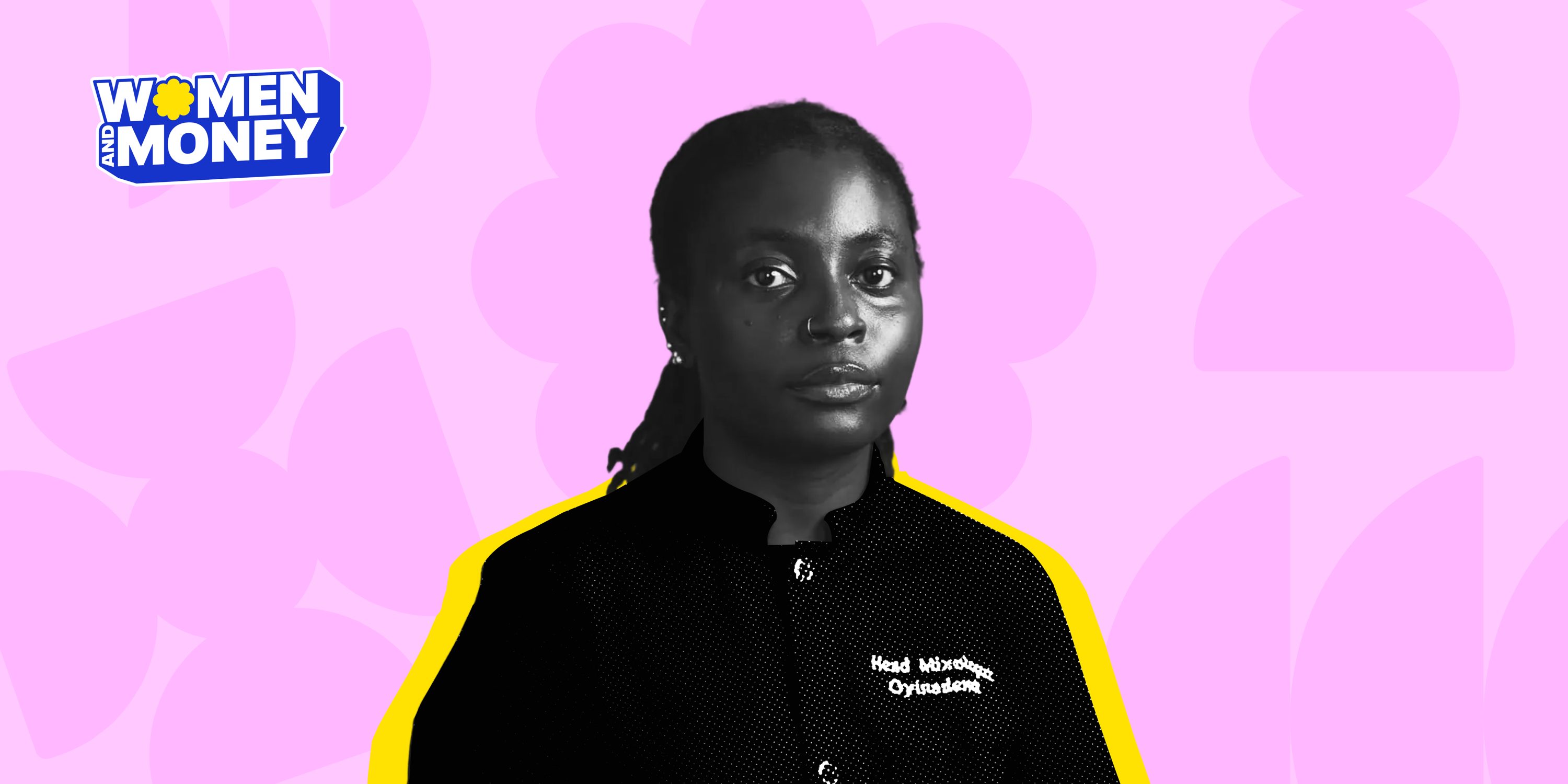
For this month’s episode of Women & Money, we spoke to 29-year-old Adesope Adedoyin Ademola Ogunruku, popularly known as “Oyinademii”. In this interview, the Lagos-based mixologist and content creator discusses how she went from selling thrifted clothes to building a cocktail concierge brand, Omuti Express, the friendship that carried her through school and career, and her vision for the next generation of female mixologists.
Could you tell me a bit about yourself?
My name is Adesope Adedoyin Ademola Ogunruku, but on Instagram, everybody knows me as Oyinademii. My actual name is Adedoyin; I just flipped it and coined “Oyinademii” out of it.
I’m a full-time mixologist and content creator. Before this, I was a presenter at Kraks TV for about five years. While I was there, I started dabbling in mixology. Then I told myself, “Let me give myself a year to do this content creation and mixology thing properly. If it doesn’t work, I have a solid CV with Kraks that I can always fall back on.” So I left, and that’s what I’ve been doing since then.
Now, I do content and mixology full-time. Online, I teach people how to drink responsibly, what to mix with their drinks, what they’re actually drinking, and what to avoid. On the service side, we cater for events, weddings and parties.
Let’s walk back to your childhood. What was your family’s financial situation like growing up?
I didn’t grow up poor. But I also didn’t grow up rich. I didn’t have the liberty to travel out of the country for holidays, but we were always comfortable. My mom made sure that she did whatever she could for us.
I knew my family had some money struggles. I was one of those kids they’d chase out of class for not paying school fees. My mom was friends with the proprietor. She used to sell the paint they used to paint the school, so sometimes, he knew it was because he hadn’t cleared her invoice. He’d see me with the kids who hadn’t paid and say, “What are you doing here? Go inside.” He couldn’t chase someone he still owed money to.
When I was in boarding school, I didn’t really see my family’s financial struggles because I was away. My mom would buy whatever provisions I needed, and she’d come on visiting day to replenish whatever was running low. I actually won “Most Endowed Locker”, meaning the person who always had provisions. When it came to the things I really needed, I had enough.
As you got older and became more aware of money, how did that evolve?
I’m a hustler, and I got that from my mom. She’s the perfect example of hustling, and I saw it firsthand. I live my life how she lives hers; I pick the bits I like and implement them in my own way.
My mom had a thrift store. She’s done everything from selling plantain chips, food, and paint to hosting an award show. I’ve seen her try so many things, fail, and do something else. That’s the same energy I live by. I don’t feel bad when something doesn’t work out; I just brush myself off and stand up.
In secondary school, I used to sell some of my provisions. If I had three Cornflakes and someone needed one quickly, I’d sell it. When I started schooling at Yabatech, I also started selling thrifted clothes to get through school.
I’ve done ushering jobs where I was paid ₦5k per gig until they promoted me to supervisor at ₦15k. I initially went to Kraks to volunteer, but there was a mix-up. The person who interviewed me wasn’t aware, so they offered me a salary. I didn’t correct them. A year later, they asked, “Weren’t you supposed to volunteer?” and I said, “Too late.”
Lucky you! Did you start saving at this point?
I didn’t really learn how to save at a young age. I learned that maybe four years ago. I was always under the impression that God would take care of His own. It was only when I started becoming an adult and wanted to buy specific things that the concept of saving came to me.
Fair enough. How did you end up at Kraks TV, and how does that connect to what you studied?
I attended Yabatech from 2014 to 2019, where I completed both my ND and HND programs in Mass Communication. During my HND in 2018, I started seeing presenters, and I’m someone who genuinely loves talking and having fun. My mom always says, “The worst thing anybody can tell you is no.” So I sent a DM to Kraks saying I’d like to learn under them, and they wouldn’t even need to pay me. They reached out for an interview, and I got the job.
How did you manage the Kraks TV job with school?
I had a conversation with my best friend, Gbemisola. I told her I liked this and thought it could do us some good, but it meant I’d miss classes sometimes. So we agreed that one person goes out and works, the other holds down school.
Gbemisola was holding down school while I went to shoot and work. Kraks asked me to come three times a week. On the rare occasions when I showed up to class, people would recognise me from Kraks’ content. When I got paid, whatever we needed to eat, Gbemisola would eat too because she was taking notes for two, writing tests for two, buying textbooks. She’d read, summarise, and dumb it down for me so exams would be easy. That also meant the salary wasn’t just mine, it was ours both.
I don’t think Kraks would have worked if Gbemisola and I didn’t have that conversation. Gbemisola has always been the person to handle decision-making, while I focused on execution. From school until now, she’s my best friend and my manager.
At what point did you decide to take mixology seriously and pursue professional training?
When you hear tech people say they’re self-taught and can build a whole working website, you realise you can basically do anything. I started creating cocktail and wine content in May 2022, and for the first six months, I had no formal training. But then people started seeing me as valuable. They’d message me in DMs asking questions, and I started to worry about sounding like an amateur.
I have a friend, ZenMaster George, who’s a fantastic mixologist. I’d tried his cocktails and absolutely loved them. When I thought of what a mixologist should look like, he came to mind. So in 2022, I went to him to learn. He taught me all the basics, flavour profiles, and even more than what I paid for because I was really into learning.
Nice!
A while later, I saw a Diageo Academy post about hiring female bartenders for a free three-month training program. I wasn’t a bartender, just a content creator and Kraks presenter. But my mom said the same thing: “What’s the worst they can say? No.” So I messaged them explaining I’d never worked at a restaurant, but I’m a content creator passionate about cocktails and mixology, and I have my basic certification.
Two months later, they called me for an interview. They said they were looking for people with bar experience because they’d be dealing with complex issues. I told them to challenge me. What I hadn’t learned behind the bar, I’d learned by watching videos and being around mixologists. They gave me a slot but warned that if I fell behind, they’d have to drop me.
I told my line manager at Kraks, and they were so supportive. They said they’d work around my schedule. The first month, they told me not to come to work at all. Before the training started, I shot a lot of content so my face would still be there even when I wasn’t around. I graduated from that program with distinction.
What happened after the Diageo training?
For my certification, I had to work at an actual bar. They posted me to Rhapsody at Ikeja GRA in November 2022, the peak period of the year. It was also the peak period for Kraks since it’s a media company.
I spoke to my line manager at Rhapsody, Mr John, and explained I’m a content creator with a 9-to-5 presenting job. I asked if my shifts could be limited to nights. He agreed. So I’d leave home in the morning with a school bag containing my Rhapsody uniform. I’d work at Kraks during the day, then go to the bunk room to shower and change. Then by evening, I’d go to Rhapsody and work until 2, 3, or 4 in the morning. The next day, the same thing.
How to Fully Recover from a Financial Setback in Nigeria

That sounds exhausting.
When December came, the club was closing at 6 or 7 AM, and I still had to be at Kraks. I did it for two months. I was a tired babe, but I was doing it, and the tips were my compensation.
I’m surrounded by beautiful people who made that season bearable. My friends would come to Rhapsody, buy drinks just so I could practice, tip me, and buy me food. Followers who didn’t know me personally would pull up, tip me, and tell me how good I was doing. I was earning a salary from Kraks and tips from Rhapsody.
You were balling!
Yes! When I finished my internship, Mr. John told me that if I wanted to come back, he could make it happen because I did very well.
After Diageo Academy, I worked at Kraks for another year. By then, I had confidence in flavour profiles and was already doing small events, making money. I told myself: one year, focus on this full-time. If it doesn’t work, find another presenting job. I dropped my resignation, left with my head high. My CEO gave me 13th-month pay and extra money for a job well done. I’ve been on my own ever since.
When you left Kraks and went full-time with content, where were you platform-wise? How has it grown?
When I left Kraks in 2023, I had 14,000 followers. From when I left until March last year, I only grew to 17,000.
I gave myself that year to focus on Omuti Express. The content wasn’t really working because I was still learning to shoot and edit myself. So my good friend, Olumide, had to teach me, and even then, I’d send him videos to review before posting. But the service part was making waves because I was already good at cocktails.
There are two sides to me: Omuti Express is the service business; Oyinademii is the content creator. I wasn’t making money from content, but the service kept me afloat. Omuti Express was making money through networking—sending pre-made cocktail bottles to people; they taste it, they like it, they give me jobs. I was already working with Red Bull and AXA Mansard by 2024. The money from those jobs funded the content: the bottles I could buy to create recipes, the wines I could review.
How did you turn this around?
I have a friend, Victoire. I called her scared and told her I was getting followers, but my account isn’t showing what I want, and that I was putting money into these expensive bottles with nothing to show for it. She told me to keep posting.
She once posted a video saying those who work from January to August will reap the benefits later, because brands have seen what they can do with you during August to December. And she was right.
Last year, I told myself I’d post every day until the end of the year. That’s what I did. Now I’m at 131K followers. That’s how much work, how much posting had to be done.
What did brand monetisation look like through that growth?
From March to August, I wasn’t making any money despite gaining followers. But Victoire was correct—people who work January to August honestly reap benefits in those later months. You’ll get jobs throughout the year, but maybe not as frequently, especially as a niche content creator. During the Ember months, alcohol brands are outside. So I had a fantastic last quarter.
How does income work for a mixologist content creator?
Payment comes in two ways. Number one: money. Real money is payment. But there’s also collaborative content—value-added content. I’m a firm believer that money isn’t everything. Sometimes, value is also everything.
I’m very big on value-add because I’m a product of value. People have believed in me and poured into me. So if you come to me and the value makes sense for my manager and me, we’ll work.
How To Stop Gambling: 8 Practical Tips For Regaining Control And Saving Money
I currently have close to 200 bottles of alcohol, and I can tell you I’ve been gifted no more than 20 bottles. Every other one I bought with my hard-earned money. I’m not at that place where I get bottles just because. But I don’t mind—I know I’ll get there.
That’s hard to believe!
You’d think I’d be surrounded by bottles as a niche creator, right? But I don’t get gifted like that. The bottles I have in my room, I buy them—they’re my babies. The bottles for Omuti Express are separate, and somewhere else. When you see me shooting with bottles behind me, those are for Oyinademii, the content creator. They don’t mix with Omuti Express’s bottles. Of those 200 bottles, the ones brands have given me personally aren’t even up to 10.
I tell myself every time: I am not behind. I am exactly where God can reach me. The season I’m in now is very important to my story, and I’m okay buying my bottles myself. God is providing.
How do you manage your finances as someone with an inconsistent income? How do you pay yourself?
To be honest, the “pay yourself” thing is only a concept. But let me be honest, for business owners reading this who can relate: Any money in my account is my salary; that’s how I look at it. But as a business owner, you know that when you make money, you need to reinvest in the business. You buy staples that the brand always needs.
As soon as money comes in, my staff tell me what we need to restock. “Ma, the passion fruit is low; we need to restock. Ma, we need more gin. Ma, we need tequila.” I make sure we don’t go below 50% of our stock.
You calculate how many bottles you use per event. In my invoice, I already know how many bottles of each spirit I need for clients’ cocktails. Then you take out money for the actual job, pay your staff, do everything you need to do, pay yourself, and put the rest back into the business. When you do jobs and those bottles run low, you restock. So everything balances.
Do you have staff on payroll or just for gigs?
Currently, I have five staff members. But only one I pay monthly because we’re about to release a new product. The other five work when we have jobs. There’s a uniform; they’ve gone through proper training. There’s a supervisor who handles everybody. We have a proper structure. When there’s a job, the supervisor calls everyone. They know what to do even when I’m not around.
Very important.
Let me share my testimony. Two years ago in December, I only gave my staff ₦10,000 each. This December that just passed? I shared bags of rice for everybody, cartons of Indomie, groundnut oil, tomatoes, everything. Everybody carried one of each. That’s a big testimony for me. From not being able to give much to now being able to properly bless my people.
In this economy? That’s big. Tell me about your products and the business side.
My first product is bottle service. You can order cocktail bottles through my business page. If you have an event and just need maybe 10 bottles, you can order from me. We sold over 2,000 bottles last year, even without heavy promotion. There are regulars who just buy bottles to keep in their fridge for when they come home from work.
Something about my brand: we don’t make cocktails you see everywhere. Our cocktails are handcrafted—cocktails you’ve probably never tasted in your life and won’t taste again if you don’t come to us. My friends beg me to make a strawberry daiquiri, and I sometimes bend because I love them, but that’s not really our thing.
As a woman in the mixology space, have you experienced any pushback or discrimination?
I don’t think I’ve allowed anything that was supposed to be in my hands leave without fighting for it. I’ve always moved with confidence, I know what I’m doing, and you cannot mess with me.
I think my hair gives me a lot of presence, and the way I dress makes people feel like they can’t play with me. I like it. When you see me wearing my glasses, it says I’m playful, but you can’t try me. Maybe if I were more feminine, I might have faced more of it. The way I dress, the way my hair looks, I guess I sort of blend in.
Your Guide To Disposable Income: Budgeting, Spending and Saving Smart in Nigeria

At a recent private event, I made a Negroni with a homemade orange tincture. An older man asked my male staff what ingredients were used. I chose not to see it as a gender thing, but as an opportunity to educate.
I greeted him and explained what I’d made. He was impressed, asked how long I’d been doing this, and said he’d never seen a female mixologist. It became an avenue for conversation.
Great perspective!
I see myself as a unicorn in my field, and unicorns are things people gawk at. When people are surprised by my profession, I don’t take offence because I’d gawk at something new too. When we were leaving that event, that same man asked for a bottle of the Negroni to take home and collected my card. Said I’d be hearing from him.
At the end of the day, a mixologist is a mixologist. A bartender is a bartender. If you’re good at what you do, you’re good at what you do. Your gender has nothing to do with it. That’s how I live my life.
What does financial freedom mean to you?
Financial freedom means being able to buy things without thinking, “Is this going to hurt me financially?” For me, it’s buying necessities and sometimes not even necessities; just pleasure-driven purchases. Because I’m just a girl. I might feel like buying something expensive today, without worrying about whether the next job will cover it.
I want generational wealth. My lineage hasn’t experienced it before, but I want to create wealth so that, even when I’m gone, my grandkids can say, “There was a woman named Adesope Adedoyin Ademola.” Dangote doesn’t have two heads.
Real.
I also want to write a will—I don’t think anybody in my family has ever had one. But you can’t share what you don’t have.
I want to give my mom the best things in life. She gave me her best, and I want to give her my best, too. I want my niece and nephew to remember me as “talk and do”—not someone who promises and fails. I don’t want to be the aunt they side-eye when I turn my back.
Financial freedom means existing fully without the restriction of money.
You mentioned you started saving about four years ago. How has that journey been?
Piggyvest has been a big part of it. The first ₦1 million I saved in my entire life was on Piggyvest. I used to struggle on Piggyvest because I didn’t know about the Flex feature—I’d put all my money in the locked savings and keep breaking it. Eventually, I went through YouTube tutorials and learned about Flex Naira, SafeLock, and everything else.
Now, whenever I have a rainy day fund, I put it in Flex Naira. Some of my jobs don’t pay instantly, and some international brands tend to pay a month later. If I need to float the business, I take from my Flex Naira, then put it back when payment comes in. My savings go into Piggybank.

I remember when the things I looked forward to buying were new jeans or sneakers. Now I look at my savings and think, “I can get a car if I want to. I can move apartments. I can buy a nice wristwatch.” It’s beautiful to see. I remember where I started, and it’s beautiful to see how much I’ve stacked.
Have you ever been scammed or made money mistakes?
Yes, they scammed me for a fridge once. One of those declutter pages online. You know the funny thing? As soon as they scammed me, I bought another fridge immediately. I didn’t want to wallow in self-pity.
Rich kid!
Haha. Life is happening. Do you want to feel sorry for yourself or pick yourself up and move on?
I told my friends, and they helped me. As I said, there’s love at home. When they stole my phone, I got a new one, but didn’t buy it alone. My friends contributed and sent me money. The person who scammed me has surely spent that money, but I’m still better off.
Agreed. What advice would you give to aspiring content creators and mixologists, especially women?
For people who want to start content or get into mixology, remember: perfection is a thief of joy. Start where you are. Nobody has life figured out. Your story is worth telling, and nobody can tell it the way you can.
Perfection makes you procrastinate until you have everything ready. But it doesn’t work that way. Perfection comes from repetition, from doing it over and over, even when it’s not perfect. Waiting for perfection steals your joy and your dreams. You’ll be on the sidelines while people are making their dreams happen.
You’re right.
For women who want to go into mixology, do it with your genuine heart and surround yourself with people who remind you how amazing you are. When you fall, they’ll dust you off and help you up.
Follow people who look like you, who have your personality traits; people whose stories you connect to, so you can say, “If this person is doing it, I can too.” Follow me. My story is grass to grace.
If you’re a woman who loves attention, believe me, as a mixologist, you get all the attention you need. Because you’re a unicorn. People will look at you and want to know how you did it, how you broke through.
Live a life of no regrets. We don’t know how much time we have left. Every day has to be a party. The greats are people who start, not people who only think. You will struggle. You will fail. But you will stand up. I tell myself that if I fail at something, it just makes my story sweeter. The problems make your story more interesting. So that’s it: just do it.
If you had to rate your financial health on a scale of 1 to 10, where would you put yourself?
I’d give myself a 1 because I’m just a girl.
But honestly, I’m the person who’s always like, “God will provide, just do you, money will come back.” I just bought a bicycle in January, when people are managing their money. My friends get angry because I act like there’s money somewhere. So I’m a strong 1. But God is with that one.